If Intelligence Becomes Abundant, What Do We Still Need to Learn?
Reflections from My First Day at OEB Global in Berlin
It’s my first time at the OEB Global Conference — a gathering of educators, researchers, learning designers, training leaders, and curious minds who care deeply about how people grow.
I arrived as something of an outsider. My world is entrepreneurship, digital transformation, and B2B commerce. Most people here come from academia or corporate learning. Yet from the moment I stepped in, it felt like exactly the right place to be.
Because if there’s one insight I’ve gained over the past years, it’s this:
Digital transformation doesn’t fail because of software.
It stalls because critical skills are missing — everywhere.
And if the future is shaped by AI, then learning itself becomes the foundation upon which everything else stands.
AI: Tool, Teammate — or the Early Stages of a Digital Species?
The opening panel set the tone for the day. Andrew Maynard didn’t start with technical definitions or predictions — he started with two unsettling, deeply human questions:
Is AI changing who we are?
Is AI a cognitive Trojan horse?

That framing stopped me for a moment.
It forced me to rethink how we should look at AI in the first place.
Sometimes it behaves like software: predictable, structured, functional.
But sometimes it behaves like something alien — learning, adapting, generating ideas, surprising even its creators.
If that’s the case, the debate about whether AI is “just a tool” becomes almost too small.
The real question may be:
How does our relationship with intelligence change when the intelligence is no longer exclusively human?
Because if intelligence becomes abundant, our advantage won’t be in knowing the answers anymore.
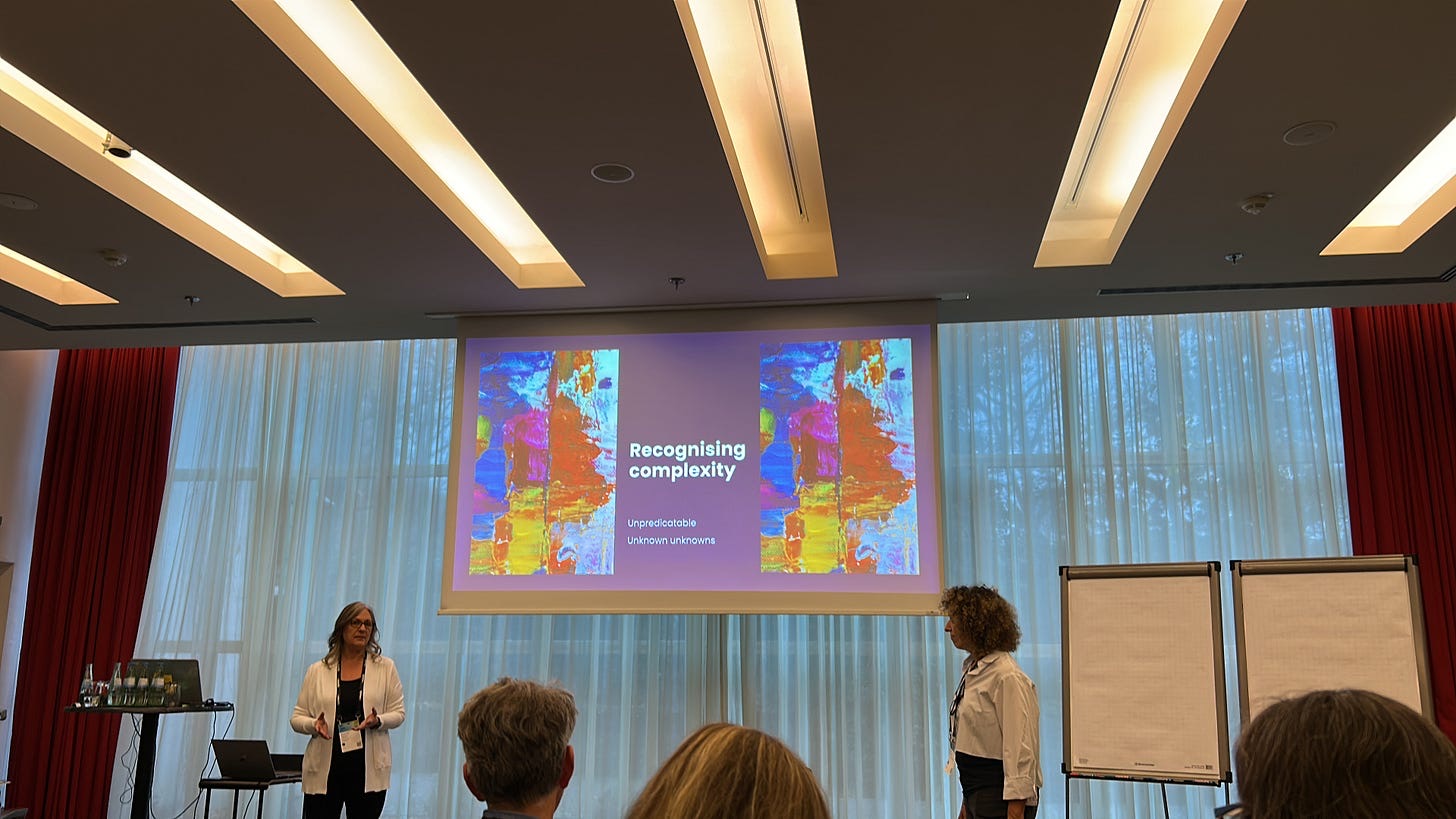
It will be in asking better questions, choosing meaningful directions, and enabling others to navigate complexity.
If that’s true, the question isn’t whether AI will replace us.
The real question is how we learn to coexist, collaborate, and grow alongside it.
Because if intelligence becomes abundant, our advantage won’t be in knowing the answers anymore.
It will be in asking better questions, choosing meaningful directions, and enabling others to navigate complexity.
That theme followed me throughout the entire day.
The Questions Behind the Technology: What Do We Value?
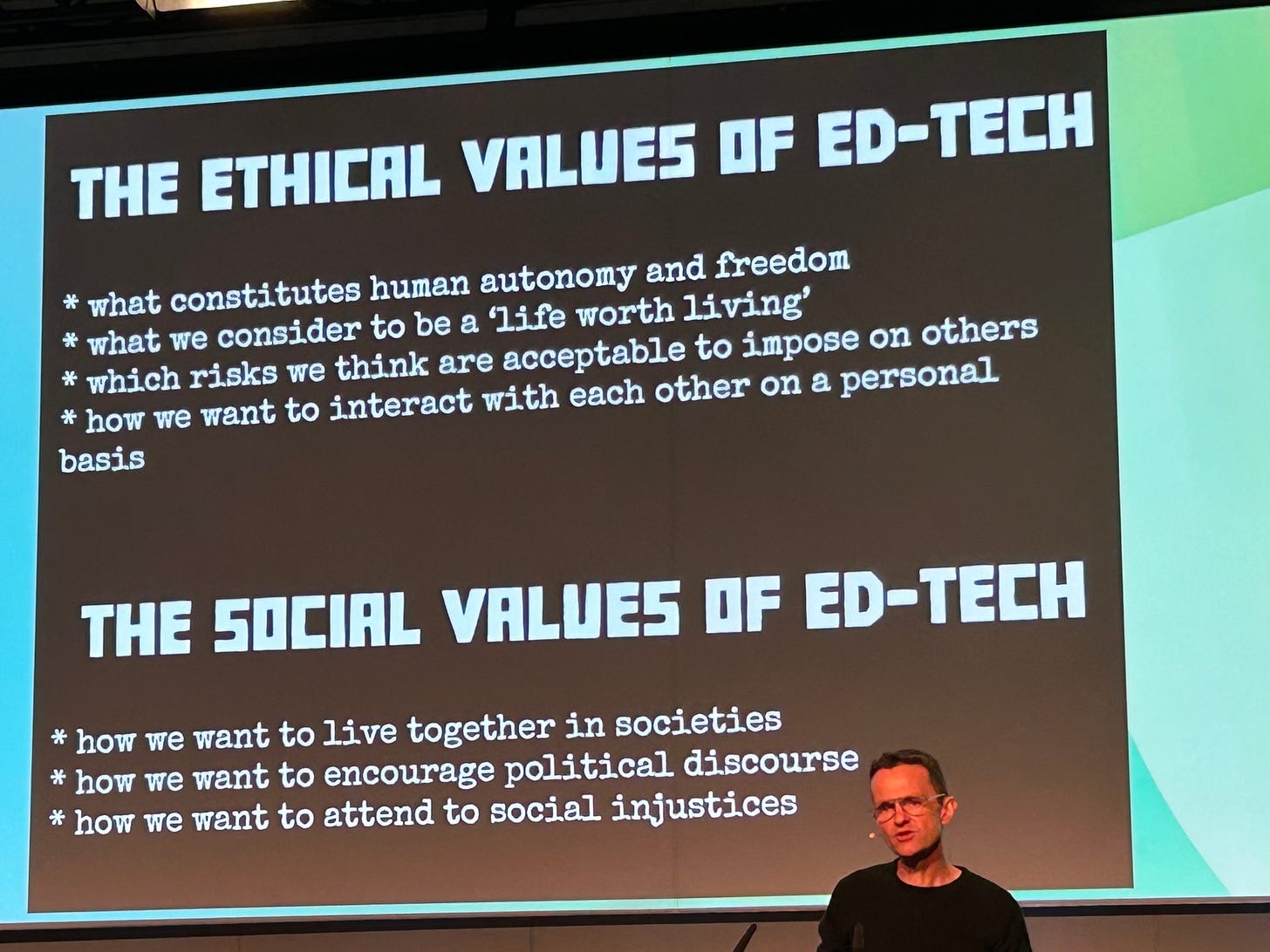
The panel didn’t only raise questions about AI itself. Prof. Neil Selwyn added an essential layer: What ethical values do we — and should we — embed into ed-tech?
In other words:
What principles should guide the systems we build?
Who benefits, and who gets left behind?
Are we designing technology that expands human potential — or simply optimises existing structures?
This grounding in values was important.
It reminded me that conversations about AI are never just technical.
They are normative. They shape what kind of society we’re building.
Only with that foundation in mind did the rest of the day unfold in a meaningful way — from microlearning to AI tutors to the philosophical questions about work and identity.
Microlearning & AI: When the Coach Lives in Your Pocket
For my first breakout session, I joined “Microlearning & AI” led by Shannon Tipton from Learning Rebels.
Shannon is not just knowledgeable — she’s a natural educator. Within minutes she had the room laughing, thinking, challenging assumptions.
But most importantly, she expanded the discussion beyond the obvious.
Microlearning today is often about shorter content, just-in-time learning, instructional design.
But what happens when AI doesn’t just help us create content… but becomes the teacher itself?
We explored scenarios where the future of learning is not a course, a module, or even a platform — but a trusted coach in your pocket.
An AI tutor available in WhatsApp.
A guide with a personality you admire — someone you want to learn from.
Someone who knows when to challenge you and when to encourage you.
The moment I showed a small demo of an AI powered WhatsApp Tutor that speaks and behaves like James Bond, something clicked … It wasn’t just novelty. It was a glimpse into how much more engaging, personalised, and human learning could become when the tutor is not generic — but a character you choose.
This idea is far bigger than microlearning.
It’s about agency, identity, and motivation in the learning process.
When Robots Take the First Rung: Rethinking Expertise in an AI World
The next session of the day shifted the energy entirely. “When Robots Take the First Rung” didn’t begin with a discussion about automation or skills.
Instead, the facilitator invited us — gently but deliberately — to step outside our usual lanes and look at the world through the eyes of people unlike ourselves.
It was unexpected.
And exactly what the room needed.
Only after this shift in perspective did the session move toward the deeper, more uncomfortable questions — the kind that linger long after a conference ends:
What do we still need to learn if AI becomes capable of doing most of our jobs?
If many people define themselves by their work, what happens when that work disappears?
If an AI tutor can teach anything one-on-one, what becomes of formal education?
Does it matter if we no longer know whether the entity we interact with is human or AI?
The conversation quickly became philosophical — but it felt earned, not abstract.
We had first widened our lens, and then we asked the big questions.
And perhaps the most actionable insight was this:
If we assume that highly capable AI tutors will be available to every learner, how would we design online courses today?
Probably very differently.
The Blind Spot: Basic Digital Skills as an Emerging Crisis
My last session of the day was with Peter Gillis from Learnovate on core digital and data skills.
Going in, I underestimated the topic.
Living in a tech-centric environment, it’s easy to forget that even basic digital tasks create real barriers for many people — things like:
setting up two-factor authentication
navigating online forms
buying a train ticket through an app
accessing government services
While we discuss advanced AI, automation, and the future of work, an entire part of society is struggling with the fundamentals. And these fundamentals are no longer optional.
This raises two possibilities:
Either AI becomes a simplifying layer between humans and complex systems —
or we radically reduce complexity and keep analog alternatives accessible for everyone.
Both require intentional design.
Both require empathy.
Both require acknowledging that not everyone lives inside a digital bubble.
The People Behind the Systems
One of the most striking impressions of the conference was the people themselves.
Educators, researchers, learning designers — they are gentle, thoughtful, deeply committed to helping people grow.
And yet, there is an underlying tension.
A world where AI automates large parts of work is unsettling — especially for those whose mission is to help humans learn.
If the need to “know” something dissolves, what are we preparing people for?
If the job market transforms faster than curricula, what role does learning serve?
But this is precisely why we need imagination.
One of humanity’s biggest advantages is our ability to envision futures before they arrive — and then shape them intentionally.
Refusing to imagine uncomfortable scenarios does not protect us from them.
It only prevents us from preparing wisely.
What This Means for Digital Transformation
After a full day at OEB, one insight keeps resurfacing:
Learning how to learn — especially with AI — will define the next decade of digital transformation.
Not learning a specific tool.
Not memorising a process.
But learning how to:
ask better questions
build trust with AI tutors
navigate complexity
stay adaptable
cultivate curiosity
enable others to do the same
This is not an education challenge.
It is a leadership challenge.
A societal challenge.
A human challenge.
AI tutors will fundamentally reshape how people learn — inside companies and beyond. Microlearning, personalisation, conversational interfaces, and on-demand coaching are not “nice to have” innovations.
They are the new infrastructure for a world where intelligence is abundant.
And if intelligence is abundant, then the purpose of learning changes too.
Closing the Day
We ended with an evening event, but I didn’t stay long.
My mind was too full — of ideas, questions, possibilities and a deep appreciation for the people who dedicate their lives to teaching others.
OEB is not a conference about technology. It is a conference about humans navigating technology. And that distinction matters more than ever.
If today is any indication, the next decade will belong to those who learn continuously, adapt fearlessly, and build systems that help others do the same.
Because if AI truly is the beginning of a new digital species, then our role is not to compete with it — but to become better learners, better teachers, and better collaborators.
And perhaps to rediscover something timeless in the process: that learning is not just a skill. It is what makes us human.
First published on Substack.